
At Integrity International, we are excited and proud to announce a new addition to our assessment suite: the ICP (INTEGRITY & COUNTERPRODUCTIVE-Risk PROFILE). This new offering is now available.
This new assessment evaluates how well a candidate's personal disposition aligns with a corporate work environment, with a specific focus on assessing an individual's "Integrated Wholeness" - including the Risk domain within the broader Integrity domain.
Where previous integrity assessments have focused primarily on measuring positive integrity traits, the ICP takes a more holistic approach by pairing those traits with their corresponding counterproductive risk indicators. This dual-domain structure gives decision-makers a fuller, more balanced picture of a candidate. This ensures the focus is not just on where candidates are likely to shine, but where risks may quietly emerge under pressure or without adequate support or supervision.
The ICP is a covert, personality-based psychometric assessment measuring two complementary domains of workplace disposition: an Integrity domain of ten positively-framed traits, and a Counterproductive Work Behaviour (CWB-Risk) domain of ten risk-framed traits. A third, independent Monitor scale assesses the reliability of the candidate’s own responses. Because Integrity and CWB-Risk are not opposite ends of a single scale but related, independently measured dispositions, the ICP reports a separate rating for each domain, as well as a combined Composite rating that integrates both.
Rather than single, stand-alone traits, Integrity and CWB-Risk are behavioural tendencies and outcomes. The assessment therefore identifies personality and character traits that reliably co-occur with, or predict, higher integrity (and lower CWB-Risk), and vice versa.
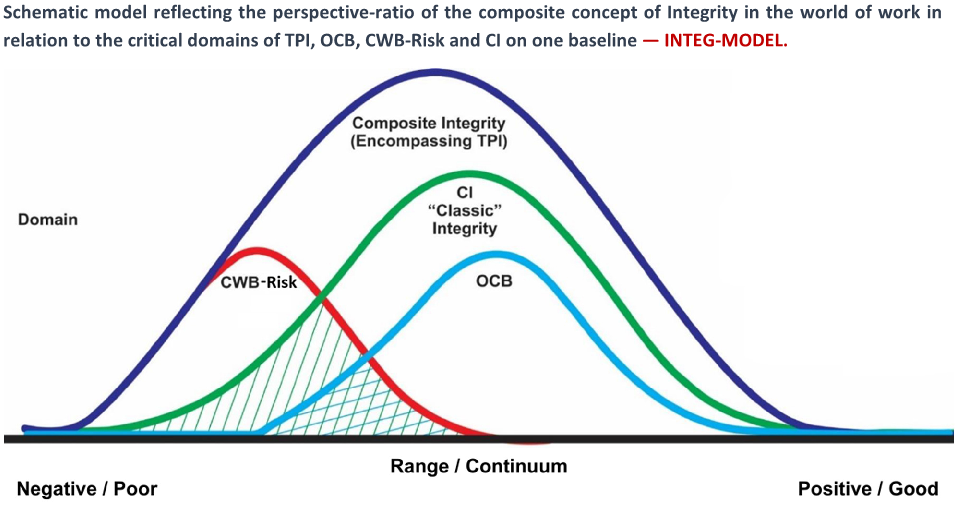
The ICP was developed from the Composite Integrity Assessment Strategy (CIAS-Model), a schematic model developed by Dr Louis J Fick over more than 30 years of research. The CIAS-Model reflects the perspective-ratio of the composite concept of integrity in the world of work in relation to four critical performance domains, set out on a single negative-to-positive continuum.

GLOSS:
OCB – Organisational Citizenship Behaviour: The candidate’s disposition to assisting/helping others (e.g., coworkers) and/or the organisation without it being “officially” demanded of him to do so and while the candidate is not expecting anything in return whatsoever.
CWB-Risk – Counterproductive Work Behaviour: The candidate’s tendency to demonstrate (or succumb to) behaviour that is to the detriment of the organisation or co-workers – ranging from a lack of commitment to blatant opposing action such as sabotage with the intention to harm the organisation and/or its employees.
TPI – Task Performance Integrity: The candidate’s orientation to work itself, in an integrity context – career development, capacity, legitimacy, work ethic, commitment, conscientiousness, performance, participation, dependability, responsibility and accountability.
CI – “Classic” Integrity: The candidate’s integrated wholeness in dealing with their (work-)life in a sincere, trustworthy, positive, consistent, honest and balanced manner.
Composite Integrity: Integrating the four broad performance domains of TPI, OCB, CWB-Risk and CI in an integrity context, to assess an employee’s overall disposition in the work environment.
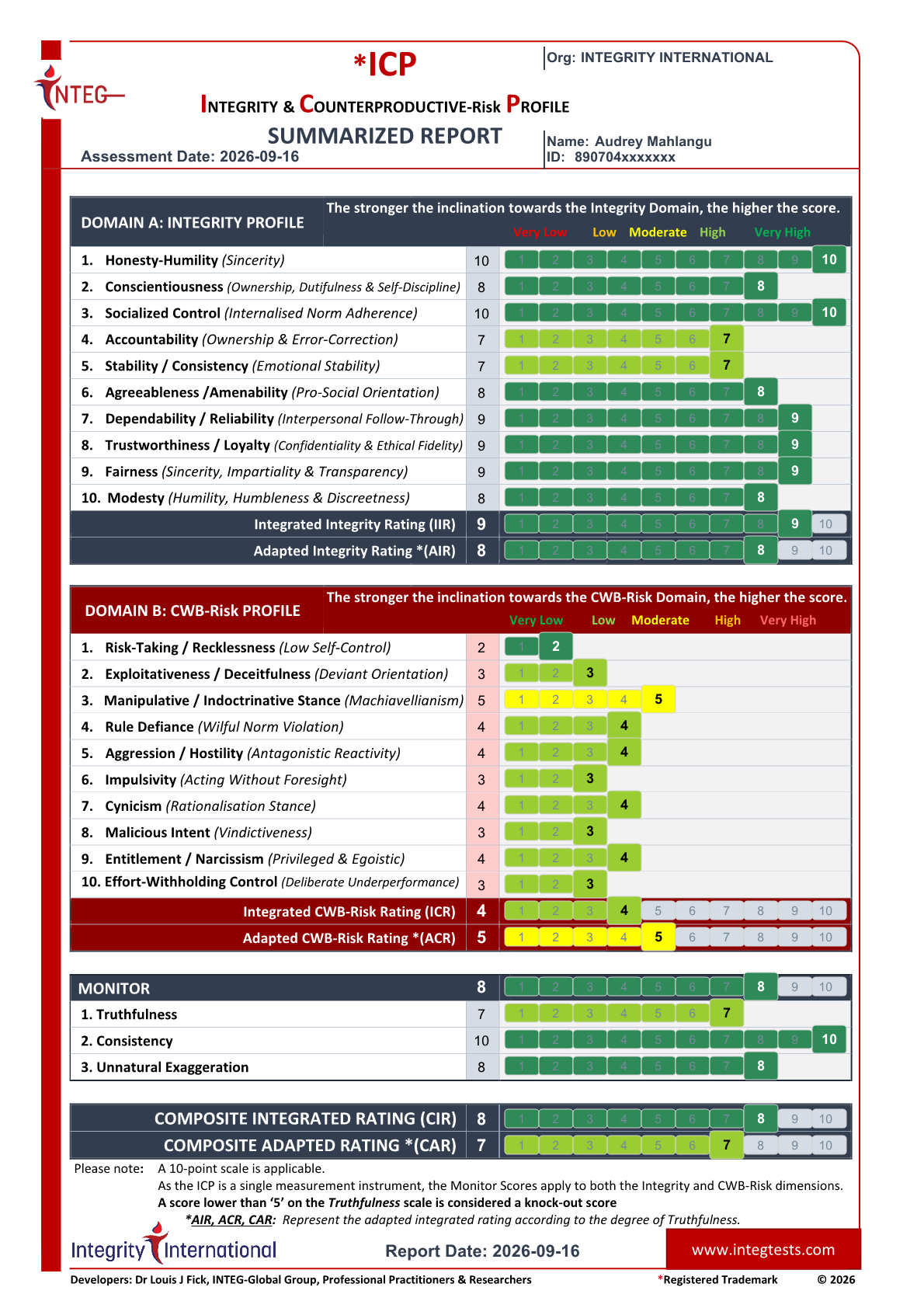
Domain A: Integrity Profile
The stronger the inclination towards the Integrity Domain, the higher the score
The ten traits covered:
Culminating in:
Domain B: CWB-Risk Profile
The stronger the inclination towards the CWB-Risk Domain, the higher the score.
The ten traits covered:
Culminating in:
Together, these two domains give a holistic picture of a candidate's integrity-related strengths and potential risk areas.
As with our other assessments, the ICP includes a built-in Monitor to safeguard response validity, consisting of:
The Monitor score applies across both domains, and notably, a Truthfulness score below 5 is considered a knock-out score.
Once the Monitor has been applied, the report culminates in two overall Composite Ratings, bringing both domains together:
This approach ensures that results can be interpreted with confidence, giving decision-makers a reliable foundation on which to base hiring or development decisions. This layered structure means decision-makers are seeing results that have already been checked for consistency and truthfulness, giving an extra layer of confidence in the outcome.
For more information regarding our new ICP assessment or to request a trial assessment, please contact us at [email protected].